480-559-1672
When Training Becomes Evidence: How Prepared Gun Owners Get Prosecuted
The quiet legal shift most gun owners never see coming
Most gun owners believe a simple equation.
More training equals more protection.
Better decisions. Better outcomes. Fewer mistakes.
That belief is not wrong.
It is incomplete.
There is a legal shift happening in self-defense cases across the country that almost no one talks about in gun stores, at the range, or in most concealed carry classes. It does not show up in marketing brochures or training certificates. It only shows up when someone is sitting at a defense table, staring at twelve strangers, while a prosecutor holds up their past decisions and asks a very specific question.
“Given your training, should you have known better?”
That question changes everything.
The standard you never agreed to
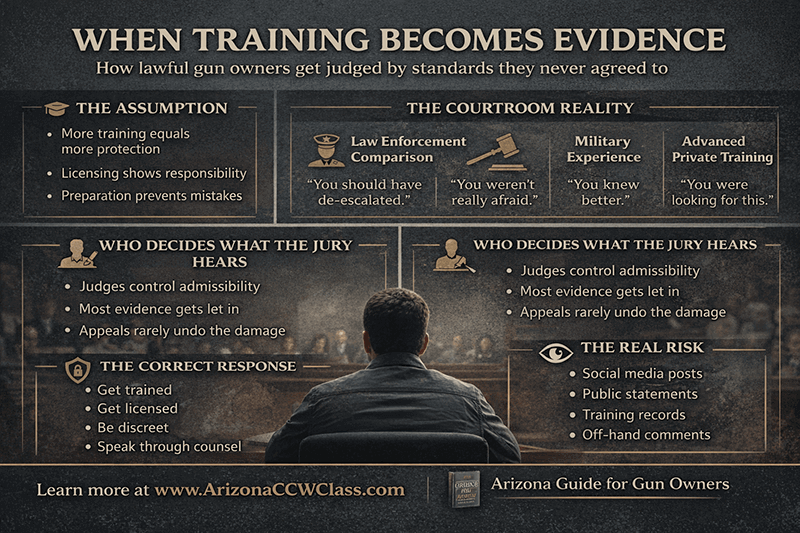
For decades, law enforcement officers were judged under a different standard. Their training, policies, and decision-making models were scrutinized after shootings. Prosecutors asked whether an officer should have de-escalated. Whether they followed procedure. Whether their training suggested another option.
What we are now seeing is that same lens quietly being turned on civilians.
Not because civilians agreed to it.
Not because the law changed.
But because courtroom strategy evolved.
Civilian defenders are increasingly being compared, implicitly or explicitly, to professionals.
Police officers.
Military veterans.
Licensed carriers.
Highly trained civilians.
The argument is not always stated outright.
It rarely needs to be.
It is implied.
You trained more than the average person.
You studied scenarios.
You practiced responses.
So why were you afraid?
Fear on trial
One of the most disturbing trends is how fear itself gets examined.
In several cases, prosecutors have attacked the very thing self-defense law is built on. A reasonable fear of imminent harm.
If you have military experience, your fear can be questioned.
If you have advanced training, your fear can be minimized.
If you carry regularly, your fear can be reframed as anticipation.
The narrative shifts subtly.
A frightened citizen becomes a calculated actor.
A defensive response becomes a chosen tactic.
A split-second decision becomes a premeditated option.
None of this requires the prosecutor to prove intent to harm.
It only requires them to create doubt about your state of mind.
That doubt is often built from your own background.
Licensing cuts both ways
Juries tend to like licensed gun owners. They like the idea of responsibility. Of paperwork. Of instruction.
Until they do not.
Because licensing creates a paradox in court.
If you are licensed, the state can argue you were trained and should have handled things differently.
If you are not licensed, the state can argue you were reckless and uninformed.
There is no safe corner here.
There is only positioning.
In at least one recent case, prosecutors went so far as to subpoena the concealed carry instructor. Not because the training was bad, but because they wanted to explore what the defendant was taught about restraint and de-escalation.
Training that was meant to help nearly became a liability.
When “more prepared” becomes “looking for trouble”
Advanced training brings its own risk.
Not in reality, but in perception.
Courses that involve scenario work.
Force-on-force drills.
Multiple firearms.
Redundancy.
In the wrong light, preparation can be reframed as obsession.
The argument is simple and dangerous.
“You were so concerned about this happening that you made it happen.”
It does not have to be true.
It only has to feel plausible to someone who does not live in the gun world.
That is the part many gun owners miss.
Courtrooms are not ranges.
Juries are not peers.
Language matters. Appearances matter. Stories matter.
Judges are gatekeepers, not guardians
Many people assume a good attorney can keep this kind of material out of court.
Sometimes they can.
Often they cannot.
Judges decide what juries get to hear. Judges are given wide discretion. In many state courts, the default posture is to let evidence in and allow jurors to sort it out.
Social media posts.
Training history.
Comments.
Photos.
Statements made under stress.
Even if a judge makes a bad call, appeals courts frequently label it “harmless error.”
Harmless to the system.
Not to the person serving time.
The lesson is not less training
This is where people get it wrong.
The answer is not to avoid training.
The answer is not to stay ignorant.
The answer is not to pretend preparation is dangerous.
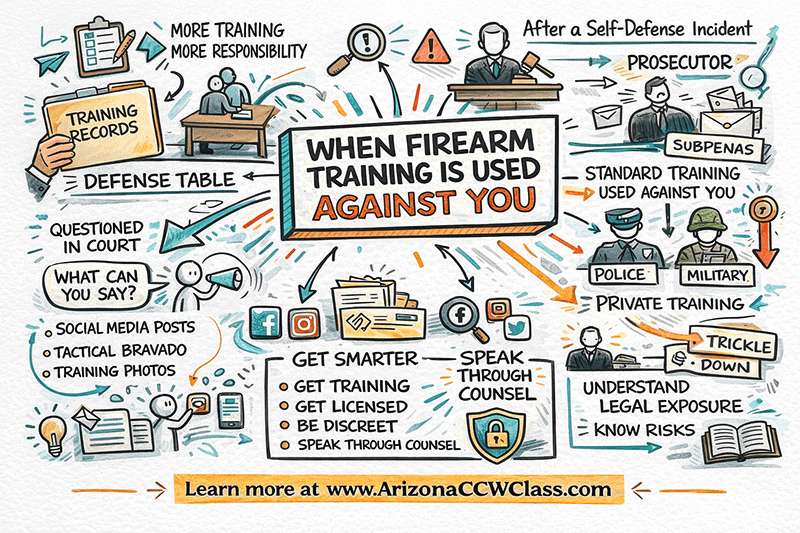
The answer is discretion.
Get trained.
Get licensed.
Get educated.
Then shut up about it.
Public declarations help no one after the fact. Neither do tactical bravado posts, jokes, or slogans that sound clever until they are read aloud in a courtroom. (eg Shoot everyone and let God sort it out).
Rights do not disappear because you exercise discretion.
They simply stop being used against you.
Silence is not guilt
After a defensive incident, everything you say becomes raw material.
Not context.
Not explanation.
Material.
Invoking your right to remain silent is not an admission.
It is strategy.
It is the difference between facts and interpretation.
This is not paranoia.
It is pattern recognition.
Why the last chapters matter
The final chapters of Arizona Guide for Gun Owners exist because the aftermath of a defensive incident is where most people fail.
Not morally.
Not tactically.
Procedurally.
Those chapters deal with mindset, exposure, consequences, and restraint. They explain how lawful people get buried under assumptions. How good intentions collide with legal realities. How to live responsibly without building a narrative that can be weaponized against you later.
Most gun books stop at mechanics.
Most classes stop at statutes.
Real life does not.
If you carry a firearm, you are already making risk decisions every day. The question is whether those decisions are informed beyond the range and the classroom.
Prepared does not mean loud.
Responsible does not mean visible.
Smart does not mean flashy.
Sometimes it means boring.
And boring is very hard to prosecute.
If you have not read the final section of Arizona Guide for Gun Owners, start there. That is where the conversation most gun owners never hear actually begins.

John Webster
JOHN WEBSTER is best-selling author of Mastering Your Fate, teacher, and coach who helps people understand complex ideas through simple, meaningful stories. He has written books on personal growth, self-leadership, and freedom, always with the goal of inspiring readers to think for themselves and live with integrity. His greatest inspiration comes from his children, Leopold and Scarlett, who remind him every day that even the smallest voices can ask the biggest questions.

Stay Informed
Subscribe now to get daily updates.
Find us on Google:
1-Hour Arizona CCW Class
Many students first discover our training through our Google listing. There you can read verified student reviews, view photos, and learn more about how the class works before scheduling your training. If you would like to see what others have said about their experience, simply search for our listing.
© 2026 John Webster - Online Arizona CCW Class


