
480-559-1672
The 2\/2 Rule That Saves Gun Owners From Ruining Their Own Defense
The 2/2 Rule That Keeps Gun Owners Out of Prison
Most gun owners believe the danger ends when the threat stops.
That belief is wrong.
The physical danger might be over, but the legal danger is often just beginning. And for many otherwise responsible people, that second phase is where everything falls apart.
After years of watching real cases play out, defense attorneys tend to agree on something uncomfortable. Most self-defense cases do not fail because the person pulled the trigger unlawfully. They fail because of what happened before the incident or what the person did afterward.
That is where the 2/2 Rule comes in.
Two things before.
Two things after.
Miss these, and even a clean defensive shooting can turn into a nightmare.
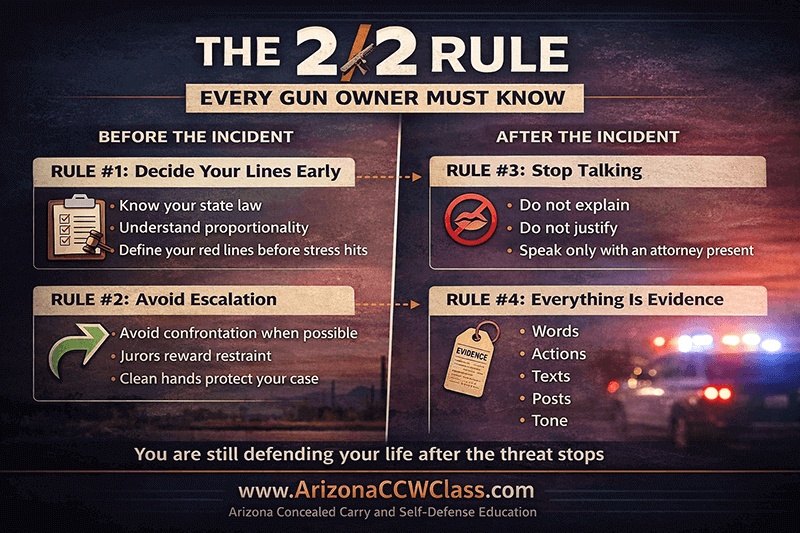
Before Rule #1: Decide Your Lines Before You Ever Need Them
When stress hits, you do not rise to the occasion. You default to whatever you already decided.
That is why thinking through self-defense scenarios ahead of time is not optional. It is essential.
Ask yourself honest questions while you are calm.
What situations would justify force in your state.
What situations would justify deadly force.
What situations would not.
Not abstract ideas. Real scenarios.
Someone approaching your car in traffic.
Someone yelling at you at a gas pump.
Someone breaking into your home.
Someone threatening you without showing a weapon.
Your state law already has answers to these situations. But if you wait until the moment arrives, you will not have time to find them.
This is where many people fail quietly. They assume good intentions equal legal protection. They do not.
Law cares about definitions. Imminence. Proportionality. Reasonableness. You must already know where your personal red lines sit inside those definitions.
If you have never walked through those scenarios in your head, you are gambling with decades of your life.
Before Rule #2: Avoidance Is Not Weakness. It Is Strategy.
This one makes people uncomfortable.
They hear avoidance and think retreat. They think surrender. They think giving something up.
That is not what it means.
Avoidance means you are not contributing to the escalation. You are not feeding the situation. You are not helping the moment boil over.
Jurors love this. Prosecutors notice it. Police respond differently when it is obvious you tried to disengage.
Even in states with no legal duty to retreat, human beings still judge behavior. And jurors are human.
If they see someone who tried to walk away, tried to de-escalate, tried to avoid the confrontation, they are far more willing to believe the use of force was necessary when it finally happened.
The people who get charged often share a common thread. Somewhere before the trigger pull, they made the situation worse instead of calmer.
Avoidance does not mean you cannot defend yourself. It means you gave yourself the cleanest legal position possible if you had to.
After Rule #1: Stop Talking. Immediately.
This is where almost everyone sabotages themselves.
You feel justified. You feel shaken. You feel relieved. You feel wronged.
And you talk.
You explain. You justify. You rationalize.
That instinct is normal. It is also dangerous.
A defensive shooting drops you instantly into the most serious legal territory of your life. Most people have never been there before. They assume honesty alone will protect them.
It will not.
Your adrenaline is high. Your memory is unreliable. Your words will be interpreted, recorded, replayed, and dissected.
This does not mean you did something wrong. It means you need counsel before you speak.
Anything worth saying is worth saying once, with an attorney present, and in a way that protects you for the rest of your life.
Silence is not guilt. It is wisdom.
After Rule #2: Assume Everything Is Evidence
From the moment the incident happens, your life becomes a file.
Your tone.
Your body language.
Your texts.
Your social media.
Your comments to friends.
Your reactions hours later.
All of it can be used.
People imagine evidence as guns and shell casings. That is only the beginning.
Prosecutors introduce Facebook posts. Angry outbursts. Offhand jokes. Arguments with police. Comments made days later when emotions settled into something uglier.
I have seen clean self-defense cases poisoned by behavior that happened after the threat was gone.
The rule is simple.
Act as if everything you do from that moment forward could be shown to a jury. Because someday, it might be.
You are still defending your life until the case is officially closed.
Why This Rule Matters More Than Gear or Training
People love to debate calibers, holsters, and features. Those things matter. But none of them will save you if you fail the legal side of self-defense.
The 2/2 Rule is not about fear. It is about foresight.
Think ahead.
Avoid escalation.
Stop talking.
Treat your life like evidence.
Do those four things consistently, and you dramatically reduce the odds of a lawful act turning into a lifelong burden.
That is not theory. That is pattern recognition.
If you carry a firearm for protection, you owe it to yourself and your family to understand this side of the equation. Because the real fight often begins after the danger stops.
And winning that fight requires discipline long before the moment arrives.
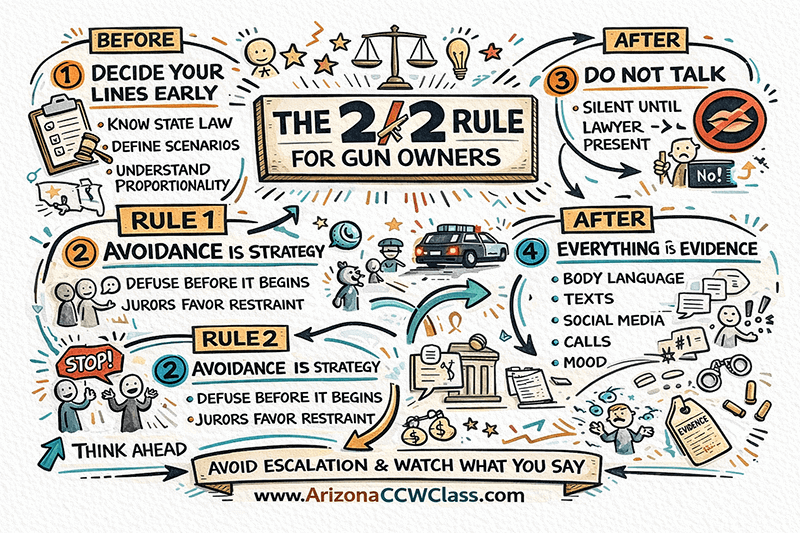
If this article made you pause, that was the point.
Most gun owners never intend to cross legal lines. They simply do not know where those lines actually are until stress removes the chance to think clearly.
The Arizona Guide for Gun Owners exists to prevent that moment.
It explains how self-defense is evaluated after the fact, what police and prosecutors focus on, and how small decisions made before and after an incident often matter more than the incident itself.
This is not a book about gear or bravado.
It is a reference for responsible people who carry firearms and want clarity instead of assumptions.
If you believe preparation includes understanding consequences, this guide belongs within reach.

John Webster
JOHN WEBSTER is best-selling author of Mastering Your Fate, teacher, and coach who helps people understand complex ideas through simple, meaningful stories. He has written books on personal growth, self-leadership, and freedom, always with the goal of inspiring readers to think for themselves and live with integrity. His greatest inspiration comes from his children, Leopold and Scarlett, who remind him every day that even the smallest voices can ask the biggest questions.

Stay Informed
Subscribe now to get daily updates.
Find us on Google:
1-Hour Arizona CCW Class
Many students first discover our training through our Google listing. There you can read verified student reviews, view photos, and learn more about how the class works before scheduling your training. If you would like to see what others have said about their experience, simply search for our listing.
© 2026 John Webster - Online Arizona CCW Class


