
480-559-1672
Concealed Carry in National Parks: The Line Most Gun Owners Cross by Accident
Concealed Carry in National Parks: What the Law Allows and Where It Stops
Most people assume National Parks are gun free zones. That assumption is wrong, and it has been wrong for years. The confusion persists because the rule is simple in principle but unforgiving in practice. One wrong doorway can turn a lawful carrier into a criminal.
If you carry a firearm for personal protection, National Parks demand more attention than most places. Not more fear. More precision.
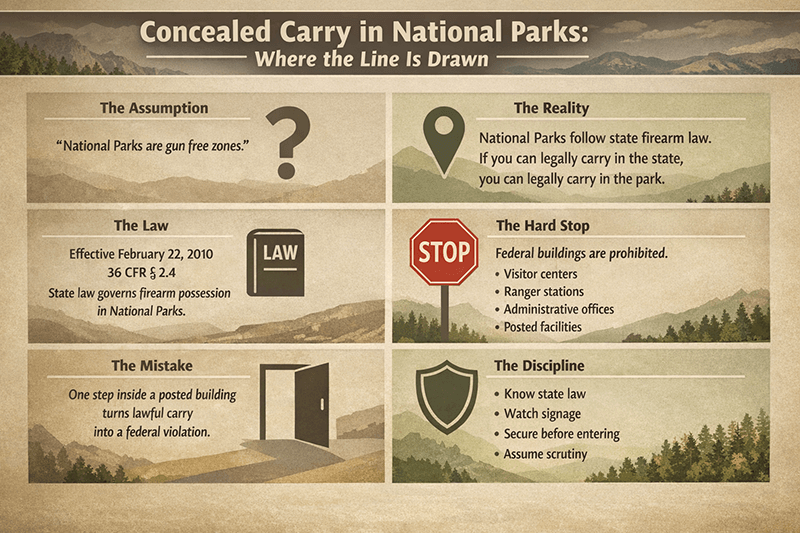
The Federal Law That Changed Everything
In 2010, federal law changed how firearms are treated in National Parks.
Effective date: February 22, 2010
Authority: Credit Card Accountability Responsibility and Disclosure Act of 2009, Section 512
Codified regulation: 36 CFR § 2.4
The rule is straightforward:
You may possess a firearm in a National Park if you are allowed to possess that firearm under the laws of the state in which the park is located.
National Parks follow state carry law, not a separate federal carry scheme.
If the state allows permitless concealed carry, the park allows it.
If the state requires a permit, the park requires it.
If your permit is recognized by that state, it is recognized in the park.
The park boundary does not erase state law. It adopts it.
Where Carry Still Stops Cold
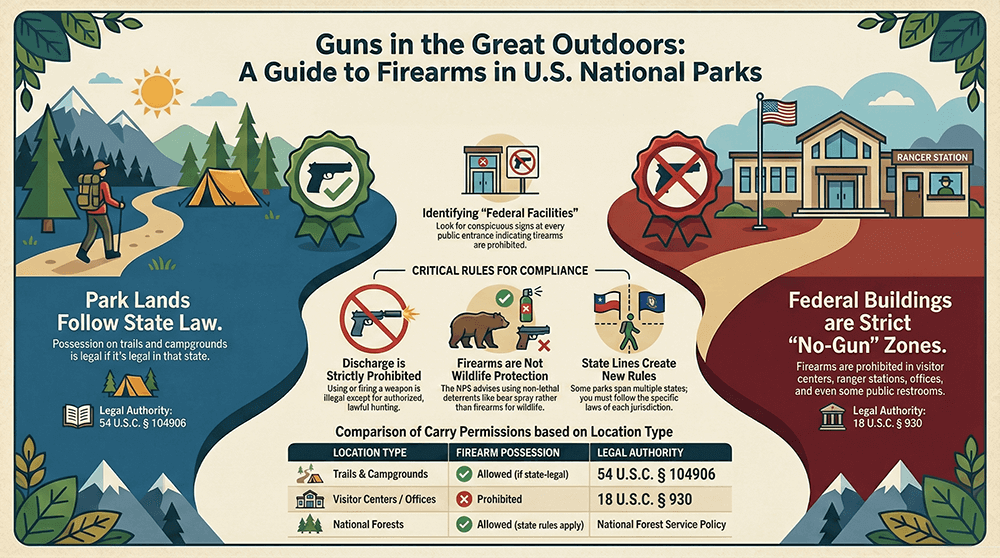
Federal buildings are a separate category. They remain prohibited, even inside a National Park.
This includes any building posted under federal law, commonly including:
Ranger stations
Visitor centers
Administrative offices
Maintenance buildings
Some gift shops or museums
Any structure with federal employees regularly working inside
These buildings are governed by 18 USC § 930. Concealed carry is not allowed inside them, regardless of state law.
The sign matters. The door matters. The threshold matters.
The mistake most people make is assuming that a gift shop inside a park is just another retail store. It is not. If it is a federal facility, carry ends at the door.
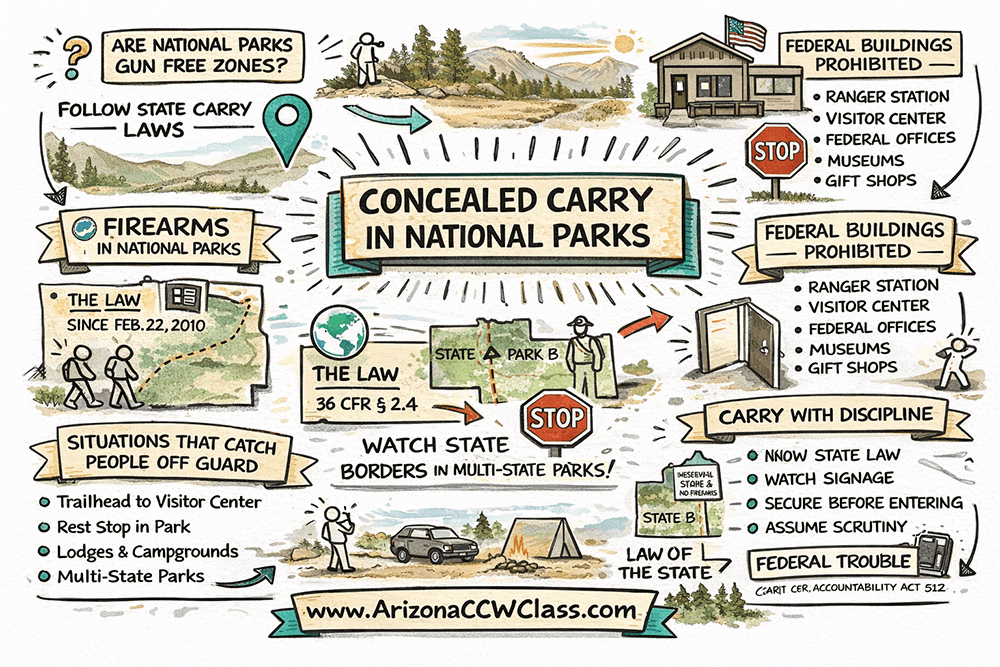
When a National Park Spans More Than One State
Some National Parks do not sit neatly inside a single border. Parks like Yellowstone, Death Valley, or Great Smoky Mountains cross state lines, and that creates a problem most concealed carriers never consider.
The rule does not change. The location does.
You follow the law of the state you are physically standing in at that moment.
National Park status does not unify carry law across state borders. Each portion of the park adopts the firearm law of the state beneath it. When you cross an internal park boundary, the governing carry law can change instantly, even though nothing around you looks different.
Example Scenario
You enter a National Park lawfully carrying under State A’s permitless carry rules. You hike several miles without issue. The trail quietly crosses into State B, where a permit is required and your permit is not recognized.
At that moment, your carry status changes.
No ranger stops you. No gate warns you. No sign announces the shift. The only thing that changes is the legal exposure.
If you continue carrying without meeting State B’s requirements, you are now in violation, even though you never left the park.
Why This Catches People
Park maps emphasize trails, not legal boundaries
GPS apps often lag or generalize borders
Visitors assume “park rules” override state lines
They do not.
The Discipline Required
If a park spans multiple states, you must plan for the most restrictive law you may encounter, or you must know exactly where those state lines are and adjust accordingly. That may mean securing your firearm before crossing a boundary or choosing a route that remains within a single state.
This is not theoretical. Multi state parks create some of the cleanest accidental violations because nothing about the environment signals danger. Only the law does.
When you carry, geography matters. Even when the scenery does not change.
Other Example Situations That Catch People Off Guard
Scenario 1: Trailhead to Visitor Center
You lawfully carry concealed while hiking in an Arizona National Park. No problem. You later step into a posted visitor center to ask about trail conditions. That single step turns lawful carry into a federal violation.
Scenario 2: Roadside Rest Stop
You pull into a National Park overlook. You remain in your vehicle. Lawful. You exit the vehicle and walk the overlook. Lawful. You enter a posted ranger kiosk restroom attached to a federal building. Not lawful.
Scenario 3: Lodging and Campgrounds
Most campgrounds and lodges inside National Parks are lawful for carry if state law allows it, unless a specific building is posted as a federal facility. Sleeping in your tent or cabin does not waive your rights. Walking into the ranger office does.
Scenario 4: Emergency Assistance
You witness an injury and approach a ranger station for help. The urgency does not override the prohibition. The firearm must stay outside the building.
This is where preparation matters. Stress compresses judgment. Familiarity with boundaries prevents mistakes.
Why This Law Exists and Why It Is Tested
The 2010 change recognized a simple reality. Criminal threats do not stop at park entrances. Remote areas, limited cell service, wildlife, and delayed response times create environments where self defense is not theoretical.
At the same time, federal facilities are treated as controlled environments. Congress drew a hard line at buildings. Courts enforce it strictly.
The law does not bend because your intentions are good. It bends only for those who planned ahead.
Practical Carry Discipline in National Parks
Know the state carry law for every park you visit
Assume buildings are prohibited unless clearly allowed
Look for federal signage before entering any structure
Secure your firearm before stepping inside posted buildings
Do not rely on memory or habit from non federal locations
Carrying responsibly means knowing when not to carry.
The Quiet Truth Most People Miss
National Parks are not lawless wilderness. They are layered jurisdictions. State law governs carry. Federal law governs buildings. Mistakes happen at transitions.
Most charges do not come from malice. They come from assumptions.
If you carry a firearm, your margin for error is thin by design. That is not an argument against carrying. It is an argument for discipline.
If you want a deeper breakdown of concealed carry boundaries, prohibited locations, and real world legal traps that follow defensive decisions, that is exactly why I wrote the book, Arizona Guide for Gun Owners. It is not written for emergencies. It is written so emergencies do not turn into prosecutions.

John Webster
JOHN WEBSTER is best-selling author of Mastering Your Fate, teacher, and coach who helps people understand complex ideas through simple, meaningful stories. He has written books on personal growth, self-leadership, and freedom, always with the goal of inspiring readers to think for themselves and live with integrity. His greatest inspiration comes from his children, Leopold and Scarlett, who remind him every day that even the smallest voices can ask the biggest questions.

Stay Informed
Subscribe now to get daily updates.
Find us on Google:
1-Hour Arizona CCW Class
Many students first discover our training through our Google listing. There you can read verified student reviews, view photos, and learn more about how the class works before scheduling your training. If you would like to see what others have said about their experience, simply search for our listing.
© 2026 John Webster - Online Arizona CCW Class


