
480-559-1672
A Court Just Crushed Washington D.C.’s 10-Round Magazine Ban… Here’s Why This Second Amendment Victory Could Affect Gun Laws Nationwide
A Major Second Amendment Victory Just Happened in Washington D.C.
And Why Every Gun Owner Should Pay Attention
If you own a firearm, I want you to imagine something for a moment.
You walk into a gun store. You buy a completely normal firearm. Nothing unusual. Nothing exotic. Just a common handgun that millions of Americans legally own.
Now imagine the government tells you something strange.
They say:
“You can own the firearm… but the magazine that normally comes with it is illegal.”
If the magazine holds more than ten rounds, you could be arrested.
You could be charged with a crime.
You could face prison.
That is exactly what happened in Washington D.C.
And recently, a court ruled that this type of law violates the Second Amendment.
This decision may end up affecting gun laws far beyond Washington D.C., because it touches on one of the most controversial gun control policies in America: magazine capacity limits.
Let me walk you through what happened in simple terms.
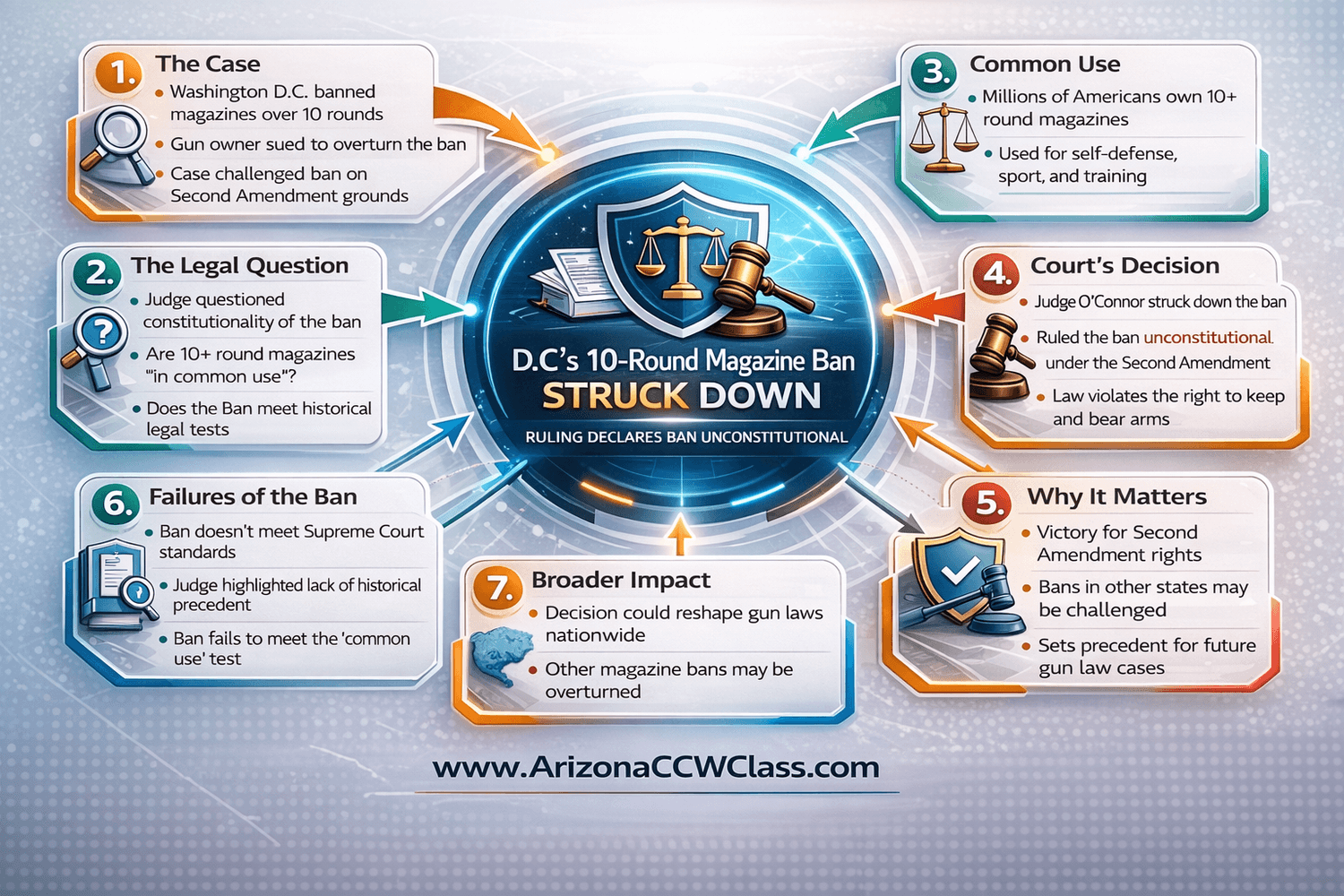
What Was the Washington D.C. Magazine Ban?
Washington D.C. had a law that banned what they called “large capacity magazines.”
The rule was simple.
If a magazine held more than 10 rounds of ammunition, it was illegal.
That means magazines holding:
11 rounds
15 rounds
17 rounds
30 rounds
were all banned.
If police found one in your possession, you could face criminal charges.
And that is exactly what happened in this case.
The Case That Triggered the Decision
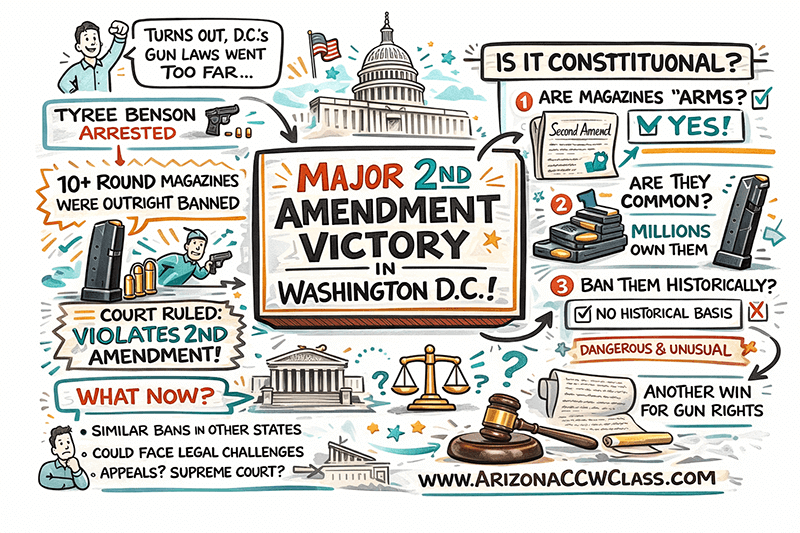
The case began when a man named Tyree Benson was arrested.
Police discovered that he had a firearm with a 30-round magazine.
Because of that magazine, he was charged with several crimes, including:
• Possessing a large capacity magazine
• Possessing an unregistered firearm
• Carrying a pistol without a license
• Possessing ammunition illegally
But Benson’s defense team challenged the charges.
They argued something very important.
They said the magazine ban itself was unconstitutional.
In other words, if the law itself violates the Constitution, then the charges based on that law cannot stand.
The court agreed.
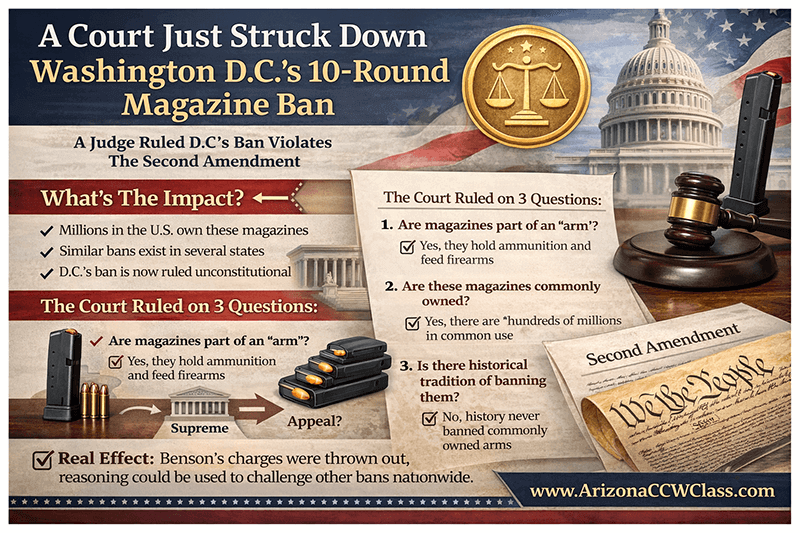
The Three Questions the Court Had to Answer
To reach their decision, the judges looked at three important questions.
These questions come directly from modern Supreme Court guidance on Second Amendment cases.
Think of them as three checkpoints.
If a law fails these checkpoints, it cannot survive.
First Question: Is a Magazine Part of an “Arm”?
The Second Amendment protects the right to keep and bear arms.
So the first issue was simple.
Is a magazine considered part of an “arm”?
The court said yes.
A magazine feeds ammunition into the firearm. Without it, many firearms cannot function properly.
For many modern firearms, the magazine is not optional equipment.
It is an essential component of the firearm itself.
Because of that, the court concluded that magazines fall within the protection of the Second Amendment.
That was the first major step in the ruling.
Second Question: Are These Magazines Commonly Owned?
The next question may be the most important one.
The Supreme Court has repeatedly said that weapons “in common use” by law-abiding citizens cannot be banned.
So the court looked at the evidence.
How common are magazines that hold more than 10 rounds?
The answer was clear.
They are extremely common.
Across the United States:
• Hundreds of millions of these magazines exist
• Many firearms are sold with them as standard equipment
• Millions of law-abiding citizens own them
In fact, magazines holding more than ten rounds make up a large portion of the magazines owned by Americans.
That matters a great deal.
Because if something is widely owned by ordinary citizens for lawful purposes, courts generally consider it protected by the Second Amendment.
The judges concluded that these magazines are not rare, unusual, or exotic.
They are normal equipment.
Third Question: Is There a Historical Tradition of Banning Them?
Modern Second Amendment cases often look to history.
The question becomes:
Did early American governments ban similar weapons?
The court looked closely at historical laws from the time the Constitution was written.
They found something important.
Early American laws did not ban commonly owned arms.
The only weapons typically banned were those considered:
dangerous and unusual.
That phrase is important.
If something is both dangerous and unusual, the government may regulate or prohibit it.
But magazines holding more than ten rounds do not meet that test.
They are not unusual.
They are extremely common.
Because of that, the court ruled that Washington D.C.’s magazine ban violates the Second Amendment.
What Happened to the Charges in This Case?
Once the court ruled that the magazine ban was unconstitutional, the rest of the case fell apart.
Why?
Because the other charges were built on top of the illegal magazine charge.
When that foundation collapsed, the other convictions could not stand.
The court reversed Benson’s convictions and sent the case back to the lower court.
In simple terms, the charges could no longer be enforced.
Why This Case Matters for Gun Owners Across America
This decision could have consequences far beyond Washington D.C.
Right now, several states have laws limiting magazine capacity.
These include places like:
California
New York
New Jersey
Colorado
Massachusetts
Hawaii
Maryland
All of these states have laws similar to the one Washington D.C. attempted to enforce.
The reasoning used in this case could influence future challenges to those laws.
Courts across the country are currently wrestling with the same question:
Can governments ban firearm equipment that millions of Americans commonly own?
This ruling strongly suggests the answer may be no.
The Court Was Not Completely United
It is important to understand that not every judge agreed with the ruling.
One judge issued a lengthy dissent.
In the dissent, the judge argued that large magazines increase the potential harm during violent crimes.
The dissent also suggested that governments should have flexibility to regulate particularly dangerous weapons.
This disagreement shows something important.
The legal debate over magazine bans is far from settled.
Many similar cases are moving through federal courts right now.
Some of them may eventually reach the United States Supreme Court.
The Bigger Lesson for Gun Owners
There is a lesson here that most gun owners do not fully understand.
Owning a firearm is only part of the responsibility.
The other part is understanding the laws that surround it.
And those laws are constantly changing.
Many gun owners assume that if they follow basic safety rules, they will be fine.
But the reality is more complicated.
A single misunderstanding of firearm laws can lead to:
criminal charges
confiscation of firearms
expensive legal battles
loss of rights
That is why understanding firearm law is just as important as understanding how to safely operate a firearm.
The Truth Many Gun Owners Learn Too Late
Most people spend hours researching which firearm to buy.
But they spend almost no time studying the laws that govern its use.
They do not fully understand:
When they can legally use force
What happens after a defensive shooting
How prosecutors evaluate self-defense claims
What mistakes can destroy a legitimate defense
These are not theoretical questions.
They are real situations that play out in courtrooms every year.
Why I Wrote Arizona Guide for Gun Owners
That is exactly why I wrote my book: Arizona Guide for Gun Owners
I wanted to create something practical.
Something that explains firearm law in clear, everyday language.
Inside the book you will learn:
How Arizona gun laws actually work
What the law says about self-defense
When you are legally justified in using force
What happens after a defensive shooting
How prosecutors analyze these cases
Most gun owners never learn these things until they are already in trouble.
My goal was to help responsible gun owners understand the system before they ever need it.
If You Own a Gun in Arizona, This Knowledge Matters
The legal system does not care whether you meant well.
It only cares whether your actions fit within the law.
Understanding those laws can mean the difference between:
freedom and prison
self-defense and criminal charges
protection and prosecution
If you own a firearm in Arizona, you owe it to yourself and your family to understand these rules.
Get Your Copy of Arizona Guide for Gun Owners
If you want to understand your rights and responsibilities as a gun owner in Arizona, I invite you to read the book.
Arizona Guide for Gun Owners explains the legal realities every responsible firearm owner should know.
You can get your copy here:
Learn the laws.
Protect your rights.
And make sure you are prepared for the situations most people never think about until it is too late.

John Webster
JOHN WEBSTER is best-selling author of Mastering Your Fate, teacher, and coach who helps people understand complex ideas through simple, meaningful stories. He has written books on personal growth, self-leadership, and freedom, always with the goal of inspiring readers to think for themselves and live with integrity. His greatest inspiration comes from his children, Leopold and Scarlett, who remind him every day that even the smallest voices can ask the biggest questions.

Stay Informed
Subscribe now to get daily updates.
Find us on Google:
1-Hour Arizona CCW Class
Many students first discover our training through our Google listing. There you can read verified student reviews, view photos, and learn more about how the class works before scheduling your training. If you would like to see what others have said about their experience, simply search for our listing.
© 2026 John Webster - Online Arizona CCW Class


